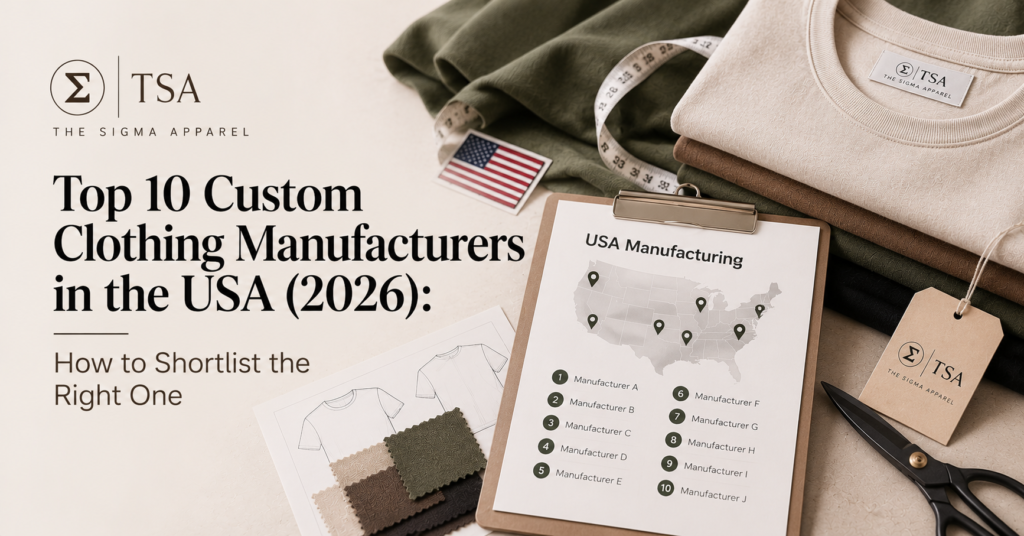
Search “custom clothing manufacturers USA” and you will get hundreds of names, from huge contract factories to one-room studios. Most of the “top 10” lists you find are really advertisements in disguise, ranked by who paid, not by who is best. The harder truth is that there is no single best manufacturer. The right one is whichever type, with whichever minimums, specialities and communication style, fits your brand right now.
This guide gives you a smarter way to shortlist. We break the US custom clothing market into ten types of manufacturer, explain what each is genuinely good at and where it falls short, and give you a scorecard to evaluate any name that lands on your list. The Sigma Apparel is included as one of those ten types, described honestly, including where we do not fit.
What a Custom Clothing Manufacturer Actually Does
A custom clothing manufacturer makes garments to your design or specification, rather than selling you ready-made stock. At minimum that means pattern-making or pattern adaptation, sampling, cutting, sewing and finishing. Many also source fabric and trims, handle printing and embroidery, add labels and packaging, and arrange shipping. The depth of that offering varies enormously, which is why comparing manufacturers is harder than comparing products. If you are new to the terminology, our explanation of what cut and sew manufacturing means covers the core process.
An Eight-Point Scorecard for Any Manufacturer
Before looking at types, it helps to know what you are scoring. Whenever you compare options, judge each one on the same eight things. Start with the minimum order quantity, both per style and per colour, because it decides whether you can even start. Then look at specialty: a factory that makes thousands of hoodies a month may be mediocre at swimwear. Examine the sampling process and its cost, since samples are where you find out whether a factory can really make your product. Check how fabric is sourced, particularly whether you must use stock fabric or can have it custom-made. Review decoration capabilities such as screen printing, embroidery and sublimation, ask about lead times and reliability, and judge communication honestly by how quickly and clearly they answer. Finally, look at reviews, references and transparency about their processes and terms. Our list of 20 questions to ask a clothing manufacturer goes into the detail behind each of these.
The 10 Types of US Custom Clothing Manufacturer
1. Full-service private label manufacturers (The Sigma Apparel)
The Sigma Apparel is a US-based custom apparel and workwear manufacturer operating from St. Petersburg, Florida, with a minimum order of 100 pieces per style. We make a broad range, including t-shirts, hoodies, jeans, jackets, activewear, swimwear, socks and workwear, and we handle decoration including screen printing, embroidery and digital sublimation.
This type is best for startups and growing brands that want one partner from design support through production, at low to mid volumes. There are things worth knowing. Our standard production estimate is about 17 business days, which is a guide rather than a guarantee. For smaller volumes we source the closest available match from ready-made market fabric, and fully custom fabric knitted to your specification requires 1,000 pieces. If you want to know more about who we are, our about us page, portfolio and brand story tell it.
2. Small-batch domestic cut-and-sew studios
Independent studios in cities such as Los Angeles, New York and Miami focus on short runs, often for fashion labels and premium streetwear. Their minimums can be very low, and the craftsmanship and communication can be excellent. The trade-offs are higher prices per piece and limited capacity, so a studio that is perfect for 50 pieces may not be able to scale when you need 500. They suit designer-led brands that value “made in USA” storytelling and tight control at small volumes.
3. Large domestic contract factories
Established contractors serving larger brands and retailers offer scale, process discipline and consistency. In exchange they typically require high minimums and may not take on small or unproven clients at all. They are a destination for brands with demonstrated demand and larger budgets, not usually a first stop.
4. Garment district sample rooms and factories
Concentrated around New York’s garment district, these businesses bring deep expertise in pattern-making, sampling and fashion-forward production, plus easy access to trims, buttons and fabric stores. They are strong for designers who want hands-on development and fast iteration, though cost and availability can be challenging.
5. Blank-based print shops and decorators
These businesses decorate existing blanks, such as printed t-shirts, hoodies and hats, rather than manufacturing garments from scratch. They are fast and low cost, and they are excellent for merchandise, events and testing designs. But you cannot change the cut, the fabric or add custom construction details, so you are limited to what the blank offers. Understanding the difference between that approach and a real manufacturing relationship is covered in our article on wholesale vs private label.
6. Sock and hosiery mills
Specialist knitters, often located in the Southeast, produce custom socks and hosiery on dedicated machines. Their expertise is narrow but deep, which makes them the right choice for products that general garment factories cannot make well. Our sock manufacturers page explains what goes into custom socks.
7. Activewear and performance specialists
Factories equipped for stretch fabrics, flatlock seams and sublimation serve fitness, yoga and team brands. They understand compression, four-way stretch and performance finishes. If you are making leggings or training gear, look at specialists such as our athletic wear manufacturers service and our custom leggings manufacturers page.
8. Workwear and uniform manufacturers
Producers of durable garments, high-visibility wear and flame-retardant clothing for trades, hospitality and industrial buyers work to different standards from fashion factories, with compliance, durability and consistent sizing across large teams at the centre. See our workwear manufacturers, industrial uniform manufacturers and flame-retardant clothing manufacturers pages for how this works.
9. Denim and jeans specialists
Denim has its own supply chain of mills, laundries and finishers, and good jeans need expertise in fit, washes and hardware. Specialists such as our denim manufacturers and jeans manufacturer services focus on that complexity, which is why they are often a separate relationship from a general garment factory.
10. Marketplaces and sourcing platforms
Directories and platforms such as Maker’s Row connect brands with manufacturers and can speed up discovery. They are a useful starting point for research and comparison, but a listing is not a guarantee of quality, so vet any manufacturer you find that way as carefully as one you found by any other route.
How the Types Compare
Full-service private label partners usually offer low-to-mid minimums and range, with fabric limits at low volumes as the main thing to watch. Small-batch studios have the lowest minimums and the best craft but the highest unit prices. Large contract factories offer scale but will not take small brands. Garment district businesses bring fashion expertise at a premium. Print shops on blanks are quick but offer no custom construction. Sock mills, activewear specialists, workwear makers and denim specialists each bring depth in one category, usually with mid-to-high minimums. Marketplaces help you find all of the above, with quality varying by listing.
Red Flags When Choosing Any Manufacturer
Some warning signs apply to every type. Be wary of vague answers about fabric sourcing and minimums, no clear sample process or an unexplained sample fee, and pressure to pay everything up front without a written order summary. Be cautious when there are no clear terms on cancellations, refunds, shipping and delays, or when the factory is reluctant to share references or past work. Always read the terms and conditions of any manufacturer before you pay.
How to Work Through Your Shortlist
Start by preparing a tech pack with sketches, measurements and fabric details, so manufacturers can quote accurately. Then email five to eight manufacturers with a clear, short brief. Compare minimums, sample costs and lead times side by side, and order samples from your top two or three, paying attention to the different types of garment samples so you know what to request. Finally, start with a small first run. For a fuller walkthrough, read our guide on how to find a clothing manufacturer, and if you are still at the planning stage, our guide to starting a clothing line is a good companion.
Frequently Asked Questions
Who is the best custom clothing manufacturer in the USA?
There is no single best. The right one depends on your product, volume, budget and timeline. Use a scorecard and test with samples.
What is the typical MOQ for a USA clothing manufacturer?
It varies from as low as a few dozen pieces at small studios to hundreds or thousands at larger factories. The Sigma Apparel’s minimum is 100 pieces per style, and our MOQ guide explains how minimums work.
Is manufacturing in the USA more expensive?
Usually per unit, yes, though shorter shipping, easier communication and quicker sampling can offset some of that.
How long does custom clothing production take?
Often several weeks from approval of samples. Our standard estimate is around 17 business days, which is a guide, not a guarantee.
Do manufacturers provide design help?
Some do, and many expect a tech pack.
Can I get fabric made to my exact spec?
At higher volumes. At lower volumes most manufacturers use the closest ready-made fabric available.
How do I vet a manufacturer?
Ask the right questions, check samples, read terms and start with a small order.
Talk to The Sigma Apparel
If you would like a no-pressure conversation about your product, contact us or start with our private label manufacturing service.