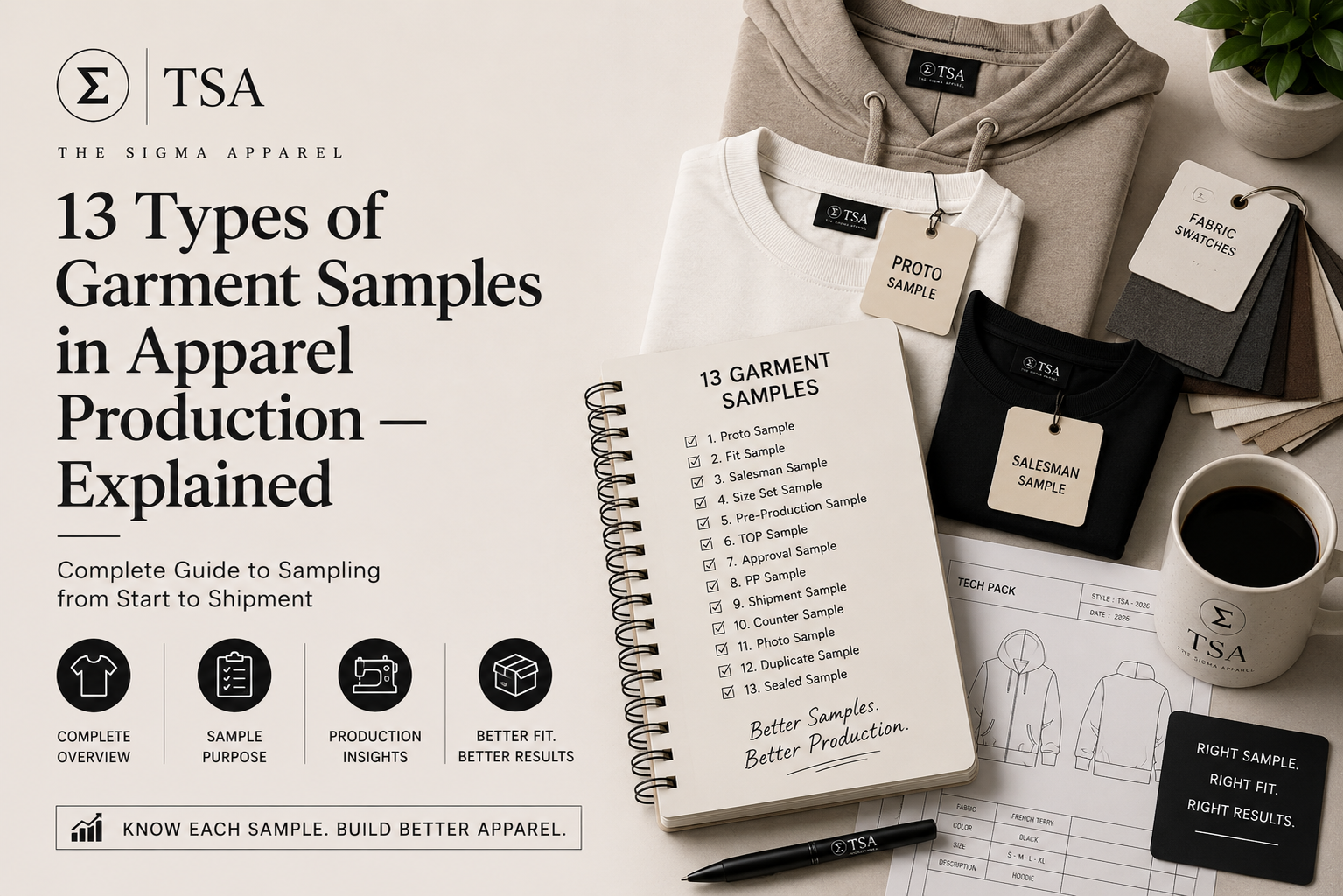
In apparel manufacturing, sampling is the bridge between your design concept and your finished product. Every professional clothing production process involves multiple types of samples at different stages — each serving a specific purpose in validating the design, fit, construction, and quality before bulk production begins.
Understanding the different types of garment samples — what they are, when they are used, and what you should be evaluating at each stage — helps you manage your production process more efficiently, avoid costly mistakes, and communicate more effectively with your manufacturing partner.
1. Concept Sample (Inspiration Sample)
A concept sample is produced very early in the design process to explore a silhouette, construction technique, or fabric combination before the design is fully developed. It is typically produced in any available fabric (not the final production fabric) and is used internally to test the viability of an idea. Most clients never see a concept sample — it is a manufacturer’s internal working tool.
2. Proto Sample (Prototype Sample)
The proto sample is the first physical version of your garment produced from your design brief. It is made in a similar (but not necessarily identical) fabric to your final specification, and it is used to evaluate the silhouette, proportion, and general construction of the design. Proto samples are typically made in a single size and colourway. For a new product being developed with Sigma Apparel’s cut and sew manufacturing team, the proto sample stage is where major design revisions happen — before expensive production materials are committed.
3. Fit Sample
A fit sample is produced specifically to evaluate the garment’s fit across the intended size range. It is made to the approved pattern and may be in the correct or similar fabric, and it is worn and tested on fit models or measured against the approved spec sheet. Multiple rounds of fit samples may be required before the pattern is finalised, particularly for garments with complex construction or a wide size range.
4. Salesman Sample (SMS / Sales Sample)
Salesman samples are produced in the correct fabric, colour, and construction for the purpose of selling to wholesale buyers, at trade shows, or for use in lookbook photography. They represent the final product as accurately as possible and are produced before bulk production begins. For DTC brands, salesman samples serve as the photography samples for product images.
5. Counter Sample
A counter sample is produced by the manufacturer to demonstrate their interpretation of a design they have been briefed on — often in response to a reference garment provided by the client rather than a full tech pack. Counter samples are evaluated against the reference garment or brief and used as a basis for discussion and refinement.
6. Pre-Production Sample (PPS)
The pre-production sample is one of the most critical sample types. It is produced using the exact production fabric, trims, labels, and construction methods that will be used in bulk — and it must be approved by the client before any bulk production begins. The PPS is the definitive reference for quality control throughout the bulk production run.
7. Size Set Sample
Size set samples are produced in all sizes of the range (XS–XXL, for example) to verify that the pattern grading is correct and that the proportions and fit translate correctly at every size. They are typically evaluated by a fit specialist or production manager before bulk cutting begins.
8. Fabric and Trim Sample
Fabric and trim samples are not garments — they are swatches of the proposed production fabric, lining, and trims (zippers, buttons, labels, elastic) sent to the client for approval before the full fabric order is placed. Approving fabric and trims before cutting begins protects against expensive mistakes with incorrect materials.
9. Wash and Test Sample
Wash and test samples are produced to verify that the garment performs correctly under the conditions it will encounter in use: repeated washing, tumble drying, ironing, and in some categories (particularly swimwear and activewear), immersion in chlorine or salt water. Colour fastness, shrinkage, shape retention, and print durability are all tested at this stage.
10. Embroidery and Print Sample
For garments that include custom embroidery or screen printing, a dedicated print or embroidery sample is produced to confirm that the design, placement, colour accuracy, and technical execution meet the approved specification before any production garments are decorated.
11. Approval Sample (Gold Seal Sample)
The gold seal sample is the single approved physical reference sample that is used as the quality standard for the entire bulk production run. It is typically signed and dated by both the client and the manufacturer and kept at the factory throughout production. Any garment that deviates significantly from the gold seal standard is flagged for correction during quality control.
12. Production Sample
A production sample is pulled from the bulk production run — after production has begun — to verify that bulk production is matching the approved gold seal standard. If a production sample reveals deviations, production may be paused for correction. For large orders, multiple production samples may be pulled at different points during the run.
13. Shipping Sample
A shipping sample is pulled from the finished, packed units just before shipment to verify that the final packaged product matches the approved standard in every respect: garment quality, folding, labelling, and packaging. It is the last quality gate before goods leave the factory.
Frequently Asked Questions
Q. How many samples should I order before bulk production?
For most new clothing brands, you should expect at least 2 to 3 rounds of samples before bulk production: a proto sample for initial design validation, a pre-production sample in final materials, and potentially a size set sample. Rushing through sampling to save time or cost is one of the most common causes of costly bulk production errors.
Q. How much do garment samples cost?
Sample costs vary by garment complexity, material cost, and manufacturer. At Sigma Apparel, sampling is included as part of the manufacturing process — we quote sampling costs as part of the overall production quote. More complex garments with specialist fabrics or hardware cost more to sample than basic knit garments.
Q. How long does it take to produce a garment sample?
Sigma Apparel produces pre-production samples within approximately 15 business days of tech pack approval. More complex garments may require slightly longer. Multiple rounds of sampling should be anticipated when planning your overall production timeline.
Q. What is the difference between a proto sample and a pre-production sample?
A proto sample is the first rough physical test of a design — produced in any available fabric to evaluate silhouette and construction. A pre-production sample is produced in the exact final materials and construction methods and must be approved by the client before bulk production begins. The PPS is the definitive quality reference for the production run.