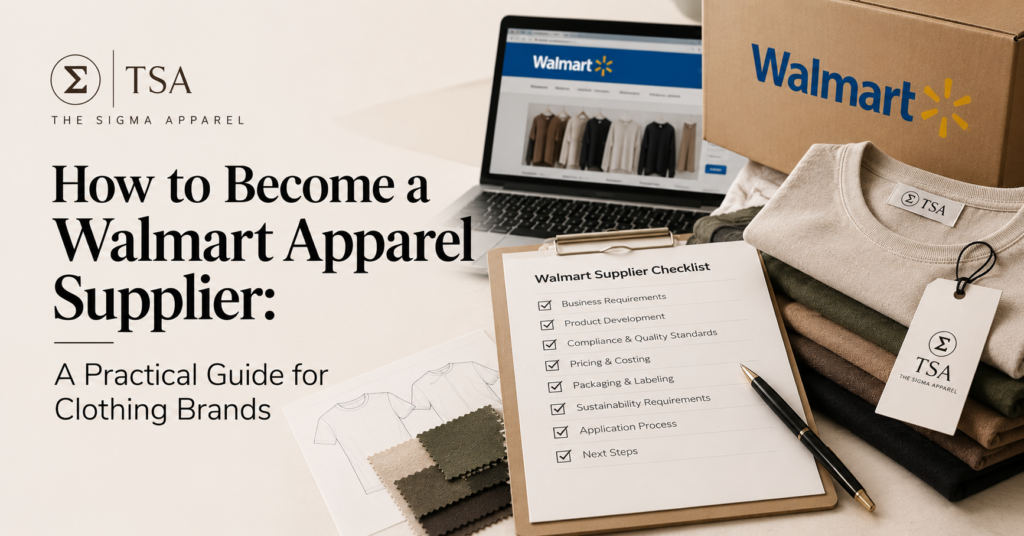
Getting your clothing line onto Walmart shelves is one of the biggest retail milestones a brand can reach. It is also one of the hardest. Walmart buys at enormous volume, demands consistent quality and expects its suppliers to meet strict standards on price, compliance and delivery. A brand that treats it as a simple application form usually discovers, a few months in, that the form was the easy part.
This guide explains how the process generally works, what you need to have in place before you apply, how to think about your production, and what alternatives make sense if you are not ready yet. One caution first: Walmart’s processes and requirements change, so treat this as a map of the terrain, and always confirm current details on Walmart’s official supplier pages before you commit time or money.
Supplier or Marketplace Seller: Decide Which Route You Want
Two very different relationships get called “selling to Walmart,” and mixing them up wastes a lot of effort. A Walmart supplier, also called a vendor, sells products wholesale to Walmart, which then stocks them in its stores, on its website or both. In that arrangement Walmart is your customer, it controls the retail price and the shelf, and you are expected to deliver at scale to its terms.
A Walmart Marketplace seller lists products on Walmart.com and sells directly to consumers, much like a third-party seller on Amazon. You keep the inventory, the pricing decisions and the customer relationship. Marketplace is far easier to start with, and it is how many smaller brands first build a sales record. Becoming a supplier means committing to volume, compliance and Walmart’s contract terms.
How the Supplier Process Generally Works
Based on Walmart’s published guidance and industry summaries of it, the path usually runs through a few stages. It starts with a submission, where you provide your company information, tax identification, and details about your product including photos, dimensions or specifications, and product identifiers such as UPC or GTIN barcodes. If Walmart is interested, you receive some form of confirmation or reference that you can use to follow up on your application.
The next stage is a supplier questionnaire, which typically asks for deeper information about your company, business identification numbers such as a DUNS number, your production locations and your capabilities. After that comes onboarding and registration, which may include signing up with required supplier systems and paying applicable registration fees. Finally you review and sign a supplier agreement. That agreement covers purchase orders, payment terms and compliance obligations, and it is binding, so it deserves careful reading, ideally with legal advice.
Walmart has also run programmes and events aimed at small businesses and US-made products, including open-call style pitch events where suppliers can present products to buyers. These change from year to year, so check Walmart’s current supplier pages for what is running.
What You Need Before You Apply
Retail at this level is not the place to work things out as you go. Buyers want to see that you are an organised, stable business with a product that is ready to sell. At a minimum that means a registered business with a tax ID and business bank account, and UPC barcodes for every product variation, correctly registered through the proper standards body. You need a proven product with consistent quality and fit, retail-ready packaging, labelling and tags, and a costed price structure that leaves room for Walmart’s margin expectations.
You also need production capacity to deliver large and repeat orders on time, compliance in areas such as fibre content labelling, care labels and country-of-origin marking, and, for children’s clothing, the relevant safety rules. Insurance is typically expected too, usually product liability cover. And buyers like to see a track record, ideally real sales from smaller retailers, your own website or marketplaces, which proves the product sells.
Be Realistic About Price and Volume
Walmart competes on price, so your cost per unit must work at a very low retail price point. That changes how you design a product from the start. Fabric choice, trims, construction and packaging all need to be tuned for cost without destroying quality. Many successful brands do not approach Walmart cold. They sell through their own store, Amazon or Walmart Marketplace, prove demand, refine the product and then go to buyers with data.
Before pitching, build a simple cost model covering fabric, trims, labour, decoration, packaging, freight and your margin, then work backwards from a realistic retail price. If you need help with the categories of expense involved, our guide to the cost to start a clothing line breaks them down.
Production: Can Your Manufacturer Handle It?
Retail buyers care deeply about who makes your goods, because a failed delivery or quality problem reflects on them. Your factory needs to deliver consistently and be able to scale. Before you commit, you should be able to answer a few questions. Can they move from a few hundred pieces to thousands per style? Do they run quality checks and provide inspection reports? Can they supply barcoded, tagged and polybagged goods? What are their lead times and how reliable is their communication? Can they support the compliance documents you will need?
Settle these early by asking the right questions to ask a clothing manufacturer, and take the time to find a clothing manufacturer that fits your stage rather than the first one that replies.
Where The Sigma Apparel Fits
The Sigma Apparel is a custom apparel and workwear manufacturer with a minimum order of 100 pieces per style. That is well suited to proving a product, building a first retail-ready collection or producing for e-commerce channels while you grow toward larger retail volume. Our standard production estimate is around 17 business days, which is a guide rather than a guarantee, and we communicate delays proactively.
We are not a shortcut into any retailer’s supplier system, and we will not claim to be. What we can do is help you make consistent, well-documented private label product that you can take to buyers with confidence. Our minimum order guide explains how quantities and fabric options work together.
Document Everything: Tech Packs and Samples
Buyers want to see that your product is fully specified and repeatable. A professional tech pack records measurements, fabric, trims, construction and packaging so that the product made in the second run matches the first. Approved production samples then become the reference standard everyone works to. These documents reduce risk for you, your factory and the buyer.
Protect Your Brand First
Before approaching a major retailer, make sure your name, logo and key designs are protected. Selling into big retail without trademark protection leaves you exposed if someone else registers or copies your brand. Our guide on how to trademark a clothing brand explains the process.
Alternatives If You Are Not Ready for Walmart
If the supplier route is premature, there are strong stepping stones. Walmart Marketplace lets you test demand. Your own Shopify or WooCommerce store builds a customer base and data. Amazon adds reach. Independent boutiques and regional chains offer smaller, more forgiving orders, and understanding wholesale vs private label helps you decide how to position your product for those buyers. Corporate and team orders for workwear or custom uniforms can also provide steady, predictable volume while your brand grows.
Frequently Asked Questions
Can a small clothing brand sell to Walmart?
Yes, but it usually takes preparation: a proven product, correct barcodes, compliant labelling, scalable production and a price that works at retail. Many small brands start on Walmart Marketplace first.
How much does it cost to become a Walmart supplier?
It depends on current onboarding and registration requirements, plus your own costs for barcodes, insurance, testing and packaging. Confirm current fees directly with Walmart.
Do I need a barcode to sell to Walmart?
Yes. Each product variation generally needs its own UPC or GTIN.
What is the difference between a Walmart supplier and a Marketplace seller?
A supplier sells wholesale to Walmart. A Marketplace seller lists products on Walmart.com and sells directly to customers.
Do I need to manufacture in the USA to sell to Walmart?
Not as a blanket rule. Walmart sources globally, and it also runs initiatives that promote US-made products. Check current programmes on its official supplier pages.
How many pieces do I need to produce for Walmart?
Retail orders can be large, so plan your production to scale reliably from sample runs to bulk volume.
Can Sigma Apparel make products for retail channels?
We manufacture private label apparel from 100 pieces per style. Contact us to discuss your plans.
Prepare Your First Retail-Ready Run
If you are building toward retail, start with a manufacturer who can document and repeat your product consistently. Talk to our team about your plan, and find more guides on our blog.