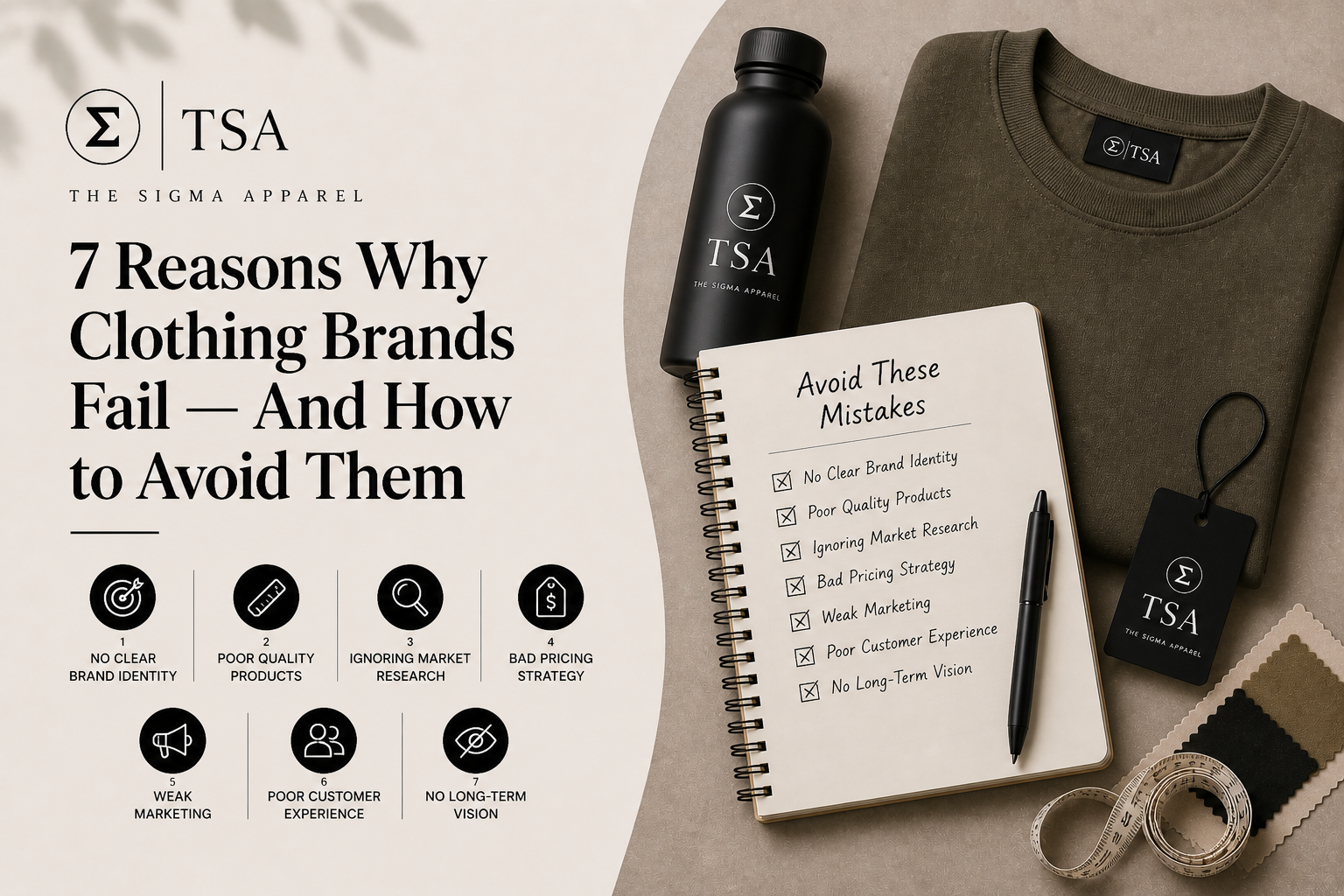
Most clothing brands fail. The statistics are sobering — research consistently shows that the majority of new fashion brands do not survive past their second year, and many never recoup their initial investment. But failure is rarely random. When you look at the brands that do not make it, the same patterns appear over and over again.
Understanding why clothing brands fail is not an exercise in pessimism — it is the most practical thing a brand founder can do before investing their money and time. Here are the seven most common reasons clothing brands fail, and exactly what to do differently.
1. Targeting Everyone and Reaching No One
The most common mistake new clothing brand founders make is defining their target audience too broadly. ‘Men and women aged 18 to 45 who like fashion’ is not a target market — it is everyone. When your brand tries to appeal to everyone, its message resonates with no one. Your product design becomes generic. Your marketing has no clear voice. Your customer acquisition cost is high because you are competing for attention across an enormous, unfocused audience.
The solution is radical specificity. Your target customer should be a real, nameable person with specific interests, values, and buying behaviour. The more precisely you understand who you are building for, the more distinctly you can design for them — and the more efficiently you can market to them.
2. Poor Product Quality That Does Not Match the Price
Customers are more sophisticated than they have ever been. They handle garments, check seams, wash and re-wear, and report quality issues publicly on social media and review platforms. A brand that charges premium prices for mid-quality products will be called out — and that reputation is almost impossible to recover from. Getting quality right starts at the manufacturing stage. Choosing a manufacturer with a proven quality assurance process, ordering a physical sample before bulk production, and using the correct fabric weight and construction for your price point are non-negotiable. Our guide to finding the right clothing manufacturer covers how to evaluate a manufacturer’s quality standards before committing.
3. Underestimating the True Cost of Starting a Clothing Brand
Most first-time brand founders significantly underestimate total startup costs. They budget for manufacturing and assume the rest is cheap. The reality is that manufacturing is just one of many significant cost centres: product development and sampling, professional photography, website development, branding and graphic design, packaging, social media advertising, influencer partnerships, warehousing, and customer service all cost money. Before spending a dollar, build a full financial model. Our guide to how much it costs to start a clothing line gives a realistic breakdown by cost category.
4. Overordering Inventory Without Validating Demand
A clothing brand that orders 1,000 units of an untested product on the assumption that customers will love it is taking enormous financial risk. If the product does not sell at the expected rate, the brand is left with a cash-draining inventory problem that can be fatal for a young business. The solution is validation before production. Pre-sell before you order. Launch a small first run at MOQ and use the sales data to inform your second order. Choose a manufacturer with a low enough MOQ to make small test runs viable.
5. No Real Differentiation From Competitors
If a customer can look at your brand and instantly name three other brands that sell essentially the same products in the same price range with the same visual identity, you do not have a brand — you have a catalogue. Differentiation in clothing comes from multiple angles: a unique aesthetic, a specific technical innovation, a particular customer community, a distinctive brand story, or an ethical manufacturing commitment that your customers genuinely care about. None of these are difficult to achieve — but all of them require intentional thought before you design your first product.
6. Neglecting the Business Side to Focus Solely on the Creative
Many clothing brands are started by people who are passionate about design and aesthetics but underestimate the commercial and operational demands of running a product business. Cash flow management, inventory planning, supplier relationship management, customer service, and financial record-keeping are not glamorous — but they are what keeps a brand alive. Before starting your clothing line, ensure you have a basic business plan that covers revenue projections, unit economics, and cash flow for at least the first 12 months.
7. Launching Too Late — or Too Early
Some founders spend years in preparation and never actually launch. Perfectionism is a business killer — a good product launched at the right moment beats a perfect product launched too late. Others rush to market with an unfinished product and a brand identity that does not connect, burning their initial marketing budget on an audience that does not convert. The right balance is a defined launch date with a minimum viable product — a small, focused collection that represents your brand’s quality and identity — and a clear marketing plan to drive awareness in the weeks around launch.
Frequently Asked Questions
Q. What is the most common reason clothing brands fail?
The most common reason is a lack of clear differentiation — the brand has no compelling reason for customers to choose it over established competitors. This is usually a symptom of targeting too broad an audience and designing products without a specific customer in mind.
Q. How long does it take for a clothing brand to become profitable?
Most successful clothing brands reach profitability within 12 to 24 months of launch, though this varies enormously based on startup costs, product margins, and sales velocity. Brands that launch with low overhead, manageable inventory levels, and strong direct-to-consumer marketing typically reach profitability faster than those with high fixed costs and wholesale-dependent distribution.
Q. How much money do I need to start a clothing brand?
A minimal but viable clothing brand launch typically requires $5,000–$20,000 covering manufacturing (first run at 100-piece MOQ), branding, photography, website, and initial marketing. This is a realistic starting point for a focused, direct-to-consumer brand with 2 to 4 products. Larger ranges, retail distribution, or higher-end product categories require proportionally more capital.